
 Syeda Yasmeen
Marketing & Digital Business Writer
Syeda Yasmeen is a Marketing & Digital
Business Writer at MarketingInno with
5 years of writing experience. Her work
covers digital marketing, SEO, content
strategy, branding, social media, online
business, and emerging digital trends.
View Author Profile →
Syeda Yasmeen
Marketing & Digital Business Writer
Syeda Yasmeen is a Marketing & Digital
Business Writer at MarketingInno with
5 years of writing experience. Her work
covers digital marketing, SEO, content
strategy, branding, social media, online
business, and emerging digital trends.
View Author Profile →
 Sameena Begum
Health, Technology & Digital Content Reviewer
Sameena Begum is a health, technology,
and digital content reviewer who reviews
selected articles to help ensure that
information is presented clearly,
accurately, and responsibly.
View Reviewer Profile →
Sameena Begum
Health, Technology & Digital Content Reviewer
Sameena Begum is a health, technology,
and digital content reviewer who reviews
selected articles to help ensure that
information is presented clearly,
accurately, and responsibly.
View Reviewer Profile →
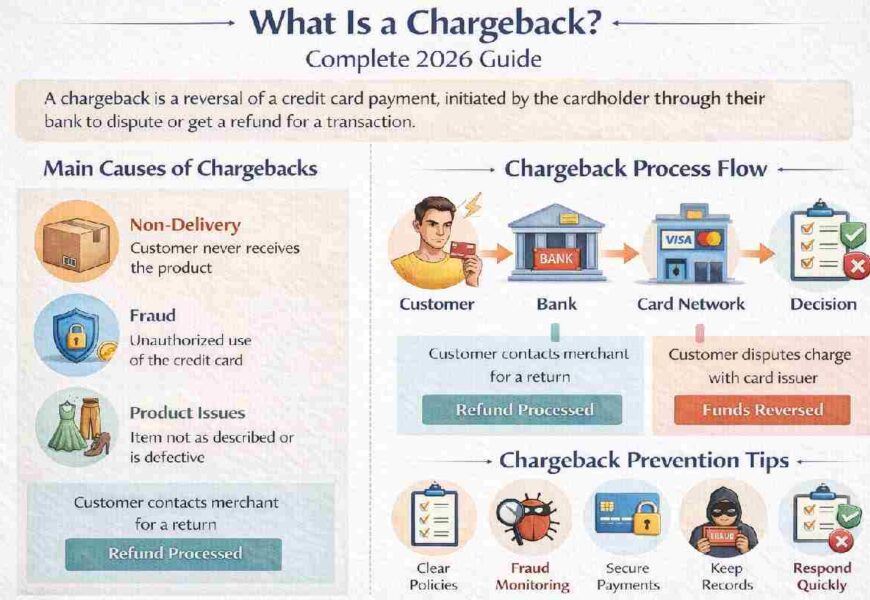
A chargeback is one of the most important concepts in digital payments, banking, and eCommerce. Whether you’re a consumer, business owner, or finance professional, understanding what is a chargeback can help you protect money, avoid fraud, and manage disputes effectively.
This research-based guide explains everything—from basics to advanced processes—so you gain complete clarity.
What Is a Chargeback and How Does It Work?
A chargeback is a payment reversal initiated by a bank or card issuer when a customer disputes a transaction. Instead of asking the merchant for a refund, the customer asks their bank to reverse the payment.
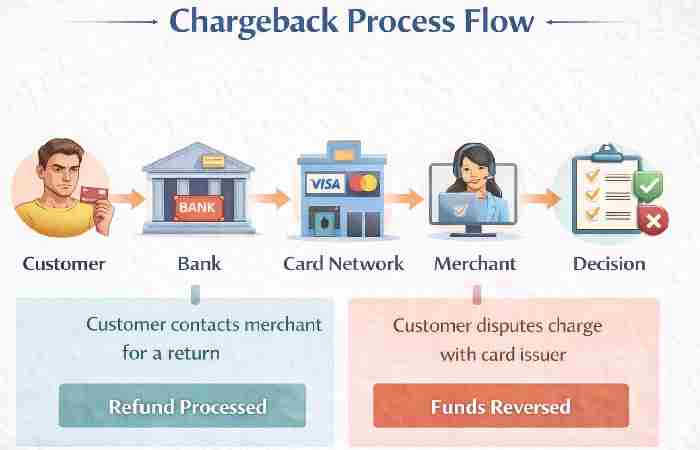
How it works (Simple Flow)
- Customer notices an issue (fraud, wrong charge, etc.)
- Customer contacts bank and raises dispute
- Bank investigates the transaction
- Amount is temporarily credited back
- Merchant responds with proof
- Final decision is made (refund or reversal confirmed)
This entire system is designed to protect consumers from fraud and unauthorized transactions.
Protecting sensitive information is an important part of preventing unauthorized transactions and reducing payment disputes. Businesses should also understand how financial data is collected, stored, and protected when handling customer payments.
Resource Link:
Visa – https://www.visa.com
Search: Visa Chargeback Management Guidelines
Visual: Chargeback Process Flow
Chargeback vs Refund
| Feature | Chargeback | Refund |
| Initiated by | Customer via bank | Merchant or customer request |
| Process | Bank-mediated | Merchant-handled |
| Time Taken | Longer (weeks/months) | Faster (few days) |
| Fees | High for merchants | Low or none |
| Impact | Damages merchant reputation | Minimal impact |
| Investigation | Yes | Usually no |
| Risk of penalty | High (chargeback ratio limits) | Low |
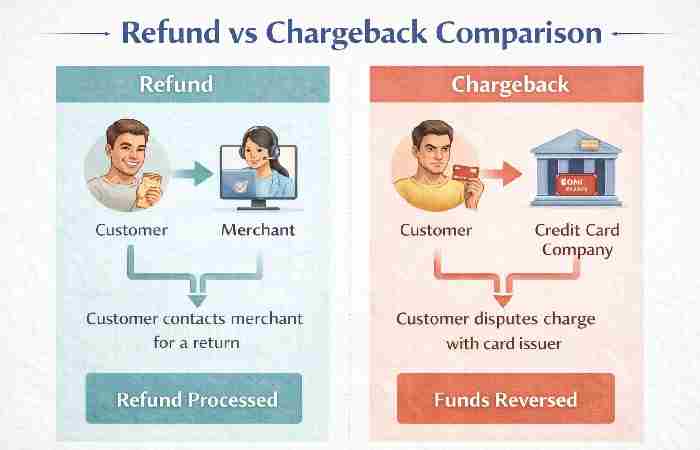
So, when asking what is a charge back vs refund, the key difference is who controls the process and how complex it is.
As digital payment methods continue to evolve, customers may also encounter cryptocurrency-related transactions outside traditional card payments. Understanding how a Bitcoin ATM works can provide useful context when considering different types of financial transactions and potential disputes.
What Is a Chargeback Fee?
A charge back fee is a penalty charged to merchants when a dispute is raised.
Chargeback Fee Breakdown
| Fee Type | Cost Range (Global) | Description |
| Processing Fee | $10 – $50 | Charged by payment processor |
| Investigation Fee | $15 – $100 | Cost of dispute handling |
| Penalty Fee | $25 – $250 | If chargeback ratio is high |
| Arbitration Fee | $250+ | If dispute escalates |
Understanding fees is essential when learning what a chargeback is from a business perspective.
The financial technology landscape continues to introduce new platforms and digital-asset opportunities. For readers exploring this area, learning about Rexas Finance can provide additional context around emerging financial technology and digital assets.
What Is a Chargeback in Banking?
In banking, what is a chargeback refers to a formal dispute process where the bank reverses a transaction due to:
- Unauthorized use of card
- Duplicate charges
- Non-delivery of goods
- Fraudulent transactions
Chargeback Process in Banking
| Step | Process Stage | Explanation |
| 1 | Transaction | Customer makes payment |
| 2 | Issue Occurs | Fraud, error, or dissatisfaction |
| 3 | Dispute Raised | Customer contacts issuing bank |
| 4 | Chargeback Initiated | Bank reverses amount temporarily |
| 5 | Merchant Response | Evidence submitted (invoice, proof, etc.) |
| 6 | Review | Bank/network evaluates |
| 7 | Final Decision | Refund confirmed or reversed |
Banking Chargeback Lifecycle
| Stage | Description |
| Dispute Raised | Customer informs bank |
| Provisional Credit | Temporary refund issued |
| Investigation | Bank checks merchant response |
| Arbitration | Card network may step in |
| Final Outcome | Funds returned or reversed back |
It is also important to distinguish payment disputes from investment-related transactions, where different rules and risks may apply. Readers researching individual market opportunities can learn more about REAX stock as a separate investment topic.
Chargeback Time Limits
Time limits vary by card network and payment method.
Charge back Timeframe
| Network | Time Limit (Customer) | Merchant Response Time |
| Visa | 120 days | 30 days |
| Mastercard | 120 days | 45 days |
| American Express | 120 days | 20–30 days |
| UPI (India) | 30–90 days | Bank dependent |
Missing deadlines can result in automatic loss of dispute.
What Is a Chargeback in Business?
For businesses, what is a chargeback means a forced transaction reversal that can result in:
- Loss of revenue
- Additional fees
- Increased fraud risk
- Possible account suspension
Impact on Businesses
| Factor | Effect |
| Revenue | Direct loss |
| Chargeback Fees | ₹500–₹3000+ per case |
| Reputation | Negative |
| Payment Gateway | May suspend account |
| Customer Trust | Decreases |
Businesses must actively manage disputes to reduce losses.
Chargebacks should not be confused with losses or disputes connected to investments and stock-market activity. For example, readers researching market information may also be interested in the Enviro Infra share price as part of their broader financial research.
Chargeback Ratio: What It Means for Businesses
The chargeback ratio is the percentage of transactions that result in charge backs.
Charge back Ratio Calculation
| Formula | Example |
| Chargebacks ÷ Total Transactions | 50 ÷ 5,000 = 1% |
Risk Levels
| Ratio | Risk Level | Impact |
| Below 0.9% | Safe | Normal operations |
| 0.9% – 1.5% | Warning | Monitoring required |
| Above 1.5% | High Risk | Account suspension possible |
This is a critical metric when analyzing what is a chargeback in business operations.
What Is a Chargeback Example?
- Real-life Example
- You order a product online but never receive it.
- You contact the seller → no response
- You ask your bank to reverse payment
- Bank initiates charge back
- Seller fails to provide proof
- You get your money back
This is a classic example explaining what a charge back in action is.
IMAGE H2 (PLACE IN MIDDLE)
Visual: Refund vs Chargeback Comparison
What Is a Chargeback in Accounting?
In accounting, what is a charge back refers to recording a reversed transaction.
Accounting Treatment
| Entry Type | Description |
| Debit | Sales return / expense |
| Credit | Cash / bank account |
| Adjustment | Revenue reduced |
It impacts financial statements and profit margins.
Chargeback Reasons (Global Data)
| Reason Code Category | Examples | Frequency |
| Fraud | Unauthorized transactions | High |
| Service Issues | Product not delivered | Medium |
| Processing Errors | Duplicate charges | Medium |
| Authorization | Expired card or declined issues | Low |
Chargeback Request UPI (India Focus)
With UPI systems like Google Pay or PhonePe, what is a chargeback works slightly differently.
- UPI Charge back Process
- Raise complaint in app
- Contact bank support
- Transaction investigated
- NPCI handles dispute resolution
Common UPI Issues
| Issue Type | Example |
| Wrong transfer | Sent to wrong number |
| Fraud | Scams or phishing |
| Failed transaction | Money debited but not credited |
What Is a Chargeback in Insurance?
In insurance, what is a chargeback occurs when:
- Premium payments are reversed
- Claims are disputed
- Fraudulent claims are detected
Insurance Chargeback Table
| Scenario | Outcome |
| Policy cancellation | Premium refunded |
| Fraud detected | Payment reversed |
| Claim rejection | Amount adjusted |
Is a Chargeback Good or Bad?
| Perspective | Good or Bad | Reason |
| Customer | Good | Protection from fraud |
| Business | Bad | Loss + penalties |
| Bank | Neutral | Compliance mechanism |
So, what is a chargeback depends on perspective—it’s beneficial for consumers but challenging for businesses.
Consumers should also be cautious when dealing with high-risk financial products and unfamiliar online platforms. Understanding binary options can help readers recognize that different types of financial transactions may involve different risks, rules, and dispute processes.
Pros and Cons of Chargebacks
Advantages
- Protects consumers from fraud
- Ensures fair transactions
- Builds trust in digital payments
Disadvantages
- High cost for merchants
- Complex process
- Can be misused by customers
Tips to Avoid Chargebacks (Global Guide)
- For Customers
- Check transaction details carefully
- Contact merchant before raising dispute
- Use secure payment methods
- For Businesses
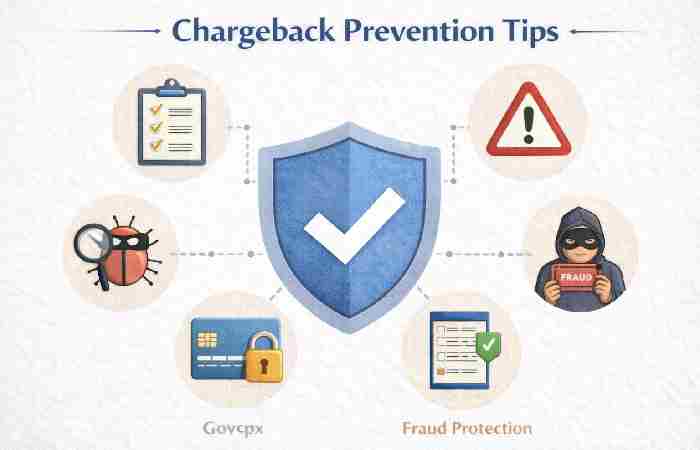
- Provide clear refund policies
- Maintain proof of delivery
- Use fraud detection tools
- Offer quick customer support
Chargeback Prevention Strategy Table
| Strategy | Benefit |
| Strong authentication | Reduces fraud |
| Clear billing | Avoids confusion |
| Customer service | Prevents disputes |
| Tracking systems | Proof for disputes |
IMAGE H2 (PLACE NEAR END)
Visual: Chargeback Prevention Tips
Future Trends in Chargebacks (2026 and Beyond)
The charge back ecosystem is evolving rapidly.
Trends to Watch
| Trend | Impact |
| AI Fraud Detection | Reduced fraud cases |
| Real-time Disputes | Faster resolution |
| Blockchain Payments | Fewer reversals |
| Stronger Regulations | Better consumer protection |
Global Chargeback Statistics
| Metric | Data (Approx) |
| Annual chargeback growth | 15–20% |
| Fraud-related chargebacks | 30–40% |
| Friendly fraud share | 60–80% |
| Average dispute cost | $50–$150 per case |
Frequently Asked Questions
Is a chargeback a refund?
No. A refund is processed by the merchant, while what is a chargeback involves the bank reversing the payment.
What is a chargeback in banking?
It is a dispute-based reversal of a transaction initiated by the bank.
What is an example of a charge back?
Unauthorized credit card use or non-delivery of goods.
What is a chargeback in business?
A forced refund that impacts merchant revenue and reputation.
Final Thoughts
Understanding what is a chargeback is essential in today’s digital economy. It protects consumers, ensures accountability, and maintains trust in online payments.
However, misuse and poor management can lead to financial losses, especially for businesses. By following best practices, both consumers and merchants can benefit from a fair and secure payment ecosystem.
Syeda Yasmeen is a Marketing & Digital Business Writer at MarketingInno with 5 years of writing experience. She covers digital marketing, SEO, content strategy, branding, social media, online business, and emerging digital trends.
View Author Profile →
Sameena Begum is a health, technology, and digital content reviewer who reviews selected articles to help ensure that information is presented clearly, accurately, and responsibly.
View Reviewer Profile →