
 Syeda Yasmeen
Marketing & Digital Business Writer
Syeda Yasmeen is a Marketing & Digital
Business Writer at MarketingInno with
5 years of writing experience. Her work
covers digital marketing, SEO, content
strategy, branding, social media, online
business, and emerging digital trends.
View Author Profile →
Syeda Yasmeen
Marketing & Digital Business Writer
Syeda Yasmeen is a Marketing & Digital
Business Writer at MarketingInno with
5 years of writing experience. Her work
covers digital marketing, SEO, content
strategy, branding, social media, online
business, and emerging digital trends.
View Author Profile →
 Sameena Begum
Health, Technology & Digital Content Reviewer
Sameena Begum is a health, technology,
and digital content reviewer who reviews
selected articles to help ensure that
information is presented clearly,
accurately, and responsibly.
View Reviewer Profile →
Sameena Begum
Health, Technology & Digital Content Reviewer
Sameena Begum is a health, technology,
and digital content reviewer who reviews
selected articles to help ensure that
information is presented clearly,
accurately, and responsibly.
View Reviewer Profile →
Marketing a small business is not easy when you are responsible for customer interaction, sales, finances, and operations of the business. It is true that a small business does not usually have enough marketing specialists and an advertising budget to spend, but it doesn’t mean you can’t do anything about it.
Actually, a small business has quite a good chance of competing if it knows who its target customers are and spends resources wisely. The small service provider will get incredible results with Google and reviews from its clients. In contrast, the e-commerce small business will definitely profit from content, social media, email, and paid ads.
It is important not to be involved in all the marketing channels at once. It is wiser to analyze your potential customers and choose marketing channels that are suitable for your business and then monitor the results.
All these marketing strategies for small businesses are very helpful in gaining publicity, attracting your potential customers, and making them become loyal ones.
What Are Marketing Strategies for Small Businesses?
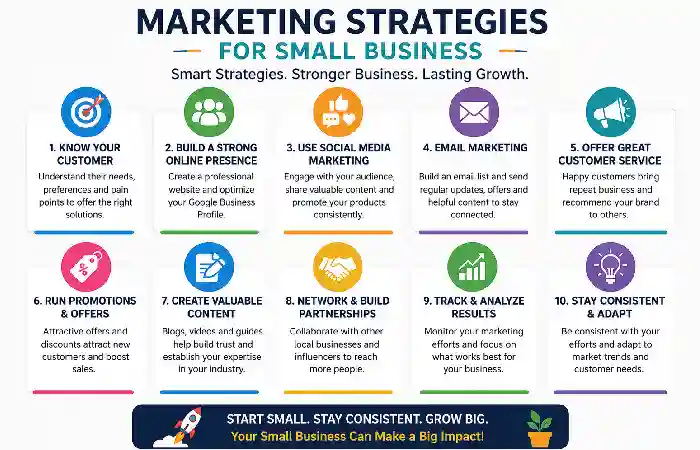
A marketing strategy is a plan used by a business in order to interact with its potential customers and persuade them to take some actions.
For a small business, the strategy may involve:
- Search engine optimization
- Content marketing
- Social media marketing
- Email marketing
- Local marketing
- Paid advertising
- Referral program
- Customer reviews
- Partnership
- Community involvement
The list is not universal. The marketing strategy of a small business providing services in a neighborhood is different from the one a small B2B software company uses.
Think of your customers first, not of the marketing channel.
Small businesses can strengthen their online presence by combining the right channels, tools, and strategies. For a broader look at the services that can support business growth, explore these digital marketing services and find the right approach for your goals.
Ask yourself:
Who Are You Trying To Reach, What Problem Do They Have, And Where Do They Look For A Solution?
Having this in mind, choosing marketing platforms will be a breeze.
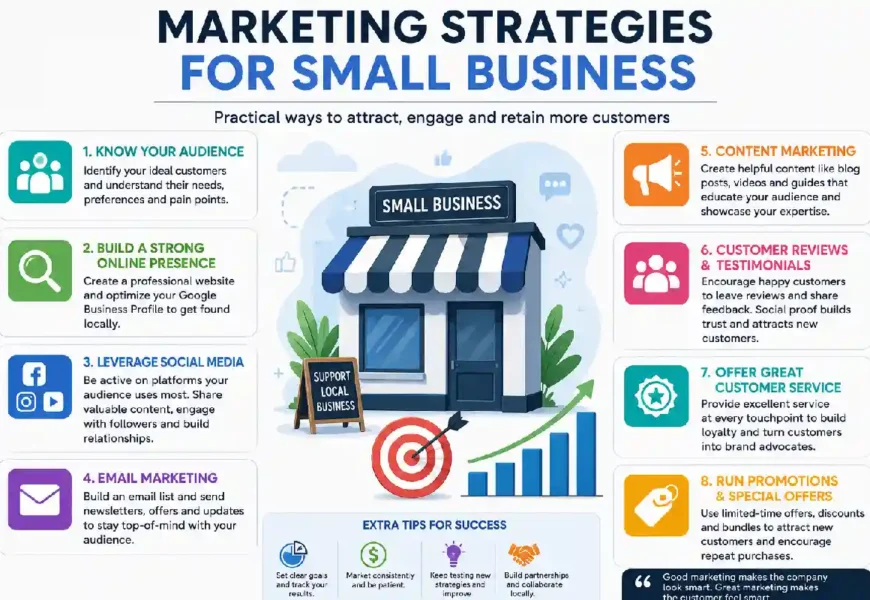
1. Find Your Target Audience
One of the fastest ways to blow a small marketing budget is to market to everybody at once.
However, one can narrow down his audience instead.
This way, he will consider:
- Age
- Geography
- Employment
- Interests
- Purchasing habits
- Issues he faces
- Budget
- Rationale for why they would choose him
For example, instead of trying to reach everyone, a personal trainer may want to target busy people who need fast workouts. This also helps to make the advertisement writing process easier, as one knows exactly whom he addresses.
2. Get Good Online Presence
Even if your company is not an online business, people tend to do some searching before spending money.
Your site should give visitors answers to questions about:
- What do you sell?
- Who is your target audience?
- Where is your business situated?
- Why do people need to use your services or buy your products?
- How can they reach you?
All this information should be available at first glance.
One should not spend time clicking on five different pages to find your phone number, price list, location, and the services you provide.
Moreover, a good site gives an opportunity to get traffic from other marketing activities to it.
Tracking your campaigns helps you understand which strategies are delivering real business results. Learn more about marketing ROI to see how businesses can measure their marketing investments and make smarter decisions.
3. Get Started with SEO
SEO is helpful for small companies because it attracts customers that are interested in a specific product or service.
In contrast to getting a top position on a keyword like “marketing,” for example, a small marketing agency can go for more specific terms like “digital marketing agency for restaurants” or “SEO services for local businesses.”
Some areas you may want to focus on are:
- Search term relevance
- Convenient content
- Page structure
- Title tags and descriptions
- Links
- Mobility
- Page loading speed
- Local SEO data if needed
As a general rule, one should look at SEO as a long-term investment rather than a way to get traffic quickly.
4. Use Local SEO
It is really helpful to use local SEO for companies that provide services in a particular area.
When people are searching for a plumber, a dentist, a restaurant, a salon, a gym, a repairman, or any other nearby business, the purchasing intent is high.
One should make sure that their company information is accurate everywhere it is needed, and encourage customers to leave reviews and respond to them.
5. Provide Useful Content
Content marketing does not imply writing some random blog posts each day.
It is more beneficial to answer questions that your potential customers may have.
For example, the company providing renovation services can write such posts as:
- How Much Does a Kitchen Renovation Cost?
- How Long Is a Bathroom Remodeling Going to Take?
- The Best Flooring for Pets
- What Should You Ask Your Contractor Before Hiring Him?
This type of content will attract visitors who are at the beginning stage of their purchasing decisions.
Not everyone from your readership will buy your products/services right away, but the useful information will make your company memorable for them.
6. Use Social Media in the Right Way
There is no need to be on all the available social media platforms.
You should identify channels where your target audience spends time.
A small company can use social media for:
- Product presentation
- Publishing customer success stories
- Answering frequently asked questions
- Demonstrating your expertise
- Publishing behind-the-scenes videos/photos
- Publishing special offers
- Providing information about the company team
You should not publish sales posts only. People will appreciate informative, interesting, and entertaining content.
7. Create an Email List
It is wonderful to have many followers on social media.
However, there are some reasons why you should create your email list, as you control it.
By means of email, you can provide your customers with:
- Information about updates to your product line
- Tips
- Your new content
- Special offers
- Invitations to events
- Customer stories
- All the important news about your business
The email list of a few subscribers who contact you often will be more useful for you than the list of many subscribers that never open your emails.
Do not forget about email marketing rules.
Building strong customer relationships is an important part of long-term business growth. Explore customer experience management to discover how businesses can create more consistent and valuable interactions throughout the customer journey.
8. Encourage Customers’ Feedback
Feedback from customers can influence their decision.
Therefore, it is important to let your customers leave a review after they have had a positive experience.
There are some options to request reviews from customers:
- Follow-up emails
- Receipts
- SMS messages
- Customers’ portals
- Personal requests
Do not create fake reviews or force customers to leave a certain rating.
9. Create a Referral Program
Your existing clients can be a source of referrals for you.
Referral marketing involves providing your customers with an incentive to refer your products or services to their friends.
For instance, a business may provide some form of reward to its customers for introducing a new client.
Depending on the industry and margins, the nature of the reward will vary.
Your referral marketing campaign needs to be easy for your customers to understand.
10. Influence and Creator Marketing

One doesn’t necessarily require a celebrity to carry out an influencer marketing campaign.
For instance, a local creator will be more effective for a small business due to their following and niche.
For example,
- A local creator in the food niche can promote a restaurant.
- A creator in the fitness niche can show a sports product.
- A technology creator can review a tech accessory.
- A creator in the local lifestyles niche can promote a new service.
While assessing creators, consider more than the number of followers. Engagement, relevance of the audience, and credibility are also very important factors. Any relationship involving payment should be disclosed per advertising law requirements.
Demonstrating your previous work can help potential customers understand your capabilities and build confidence in your business. A strong marketing portfolio can showcase successful campaigns, creative projects, and the results you have achieved.
11. Be Cautious With Paid Advertisements
While the visibility of a paid advertisement is faster than that of an organic ad, a paid ad can drain your budget easily.
Identify what your main objective is.
Are you trying to get:
- Visits to your website?
- Calls from customers?
- Clients?
- Sales online?
- Client visits to physical store?
- Applications downloaded from your app store?
Track the result rather than just views on the advertisement.
Start with a small budget and scale up if it is working well.
12. Business Partnerships
A partnership will help you reach clients through the network of another business.
For instance, a wedding photographer can partner with:
- Wedding planners
- Florists
- Event venues
- Makeup artists
- Dress shops
A fitness studio may consider collaboration with healthy meal providers and sports retailers.
The best partnership is one which works both ways and is mutually beneficial to both companies.
13. Use Promotions, but Do Not Train Customers to Wait
Promotions work since they grab attention; however, the constant use of discounts may hurt the bottom line and train the customers to wait until there is a sale.
There are plenty of ways to promote that do not involve offering discounts on everything.
Here are just a few of them:
- New customer offers
- Seasonal promotions
- Bundles
- Loyalty programs
- Time-limited packages
- Referral programs
Moreover, remember to set the goal of each promotion.
Trying too many marketing tactics without a clear plan can make your efforts difficult to manage and measure. Learn how to avoid marketing mayhem by creating a more focused strategy with clear priorities and measurable goals.
14. Track What Works
It is easy to make marketing decisions when supported by numbers.
Marketing decisions supported by numbers are easy to make.
At a minimum, track metrics such as:
| Metric | What it tells you |
| Website traffic | How many people visit |
| Leads | Potential customers generated |
| Conversion rate | How many visitors take action |
| Cost per lead | How much lead generation costs |
| Sales | Revenue generated |
| Email engagement | How subscribers respond |
| Customer retention | How well you keep customers |
| Return on ad spend | Advertising efficiency |
Any small business can start a marketing campaign with a few key numbers and analyze them consistently.
15. Focus on Customer Retention
Getting a new customer is just one of the aspects of marketing.
Customer retention can be as important, if not even more important, than acquisition.
Consider what will help you retain the client:
- Good service
- Follow-up
- Loyalty program
- Personalized advice
- Good communication
- Product quality
A customer who has already purchased from you understands who you are. It will be easier to provide them with a good experience than to attract an entirely new customer.
As a small business grows into new locations or markets, maintaining a recognizable brand while adapting to local audiences becomes increasingly important. Explore balancing local business growth with global consistency for practical ideas on maintaining this balance.
Conclusion
Effective marketing strategies for a small business do not have to be costly or require a large marketing team.
First of all, it requires understanding the audience and the proper choice of marketing channels. Once this is done, a combination of SEO, helpful content, social media, email marketing, reviews, referral programs, partners, and advertising can give you a constant flow of attention and customers.
Do not use all the available marketing tools simultaneously. Just choose two or three of them and set realistic goals, then track and improve marketing as you learn more about your audience.
Consistency and relevancy may be more important than expenses for small businesses.
Syeda Yasmeen is a Marketing & Digital Business Writer at MarketingInno with 5 years of writing experience. She covers digital marketing, SEO, content strategy, branding, social media, online business, and emerging digital trends.
View Author Profile →
Sameena Begum is a health, technology, and digital content reviewer who reviews selected articles to help ensure that information is presented clearly, accurately, and responsibly.
View Reviewer Profile →