
 Syeda Yasmeen
Marketing & Digital Business Writer
Syeda Yasmeen is a Marketing & Digital
Business Writer at MarketingInno with
5 years of writing experience. Her work
covers digital marketing, SEO, content
strategy, branding, social media, online
business, and emerging digital trends.
View Author Profile →
Syeda Yasmeen
Marketing & Digital Business Writer
Syeda Yasmeen is a Marketing & Digital
Business Writer at MarketingInno with
5 years of writing experience. Her work
covers digital marketing, SEO, content
strategy, branding, social media, online
business, and emerging digital trends.
View Author Profile →
 Sameena Begum
Health, Technology & Digital Content Reviewer
Sameena Begum is a health, technology,
and digital content reviewer who reviews
selected articles to help ensure that
information is presented clearly,
accurately, and responsibly.
View Reviewer Profile →
Sameena Begum
Health, Technology & Digital Content Reviewer
Sameena Begum is a health, technology,
and digital content reviewer who reviews
selected articles to help ensure that
information is presented clearly,
accurately, and responsibly.
View Reviewer Profile →
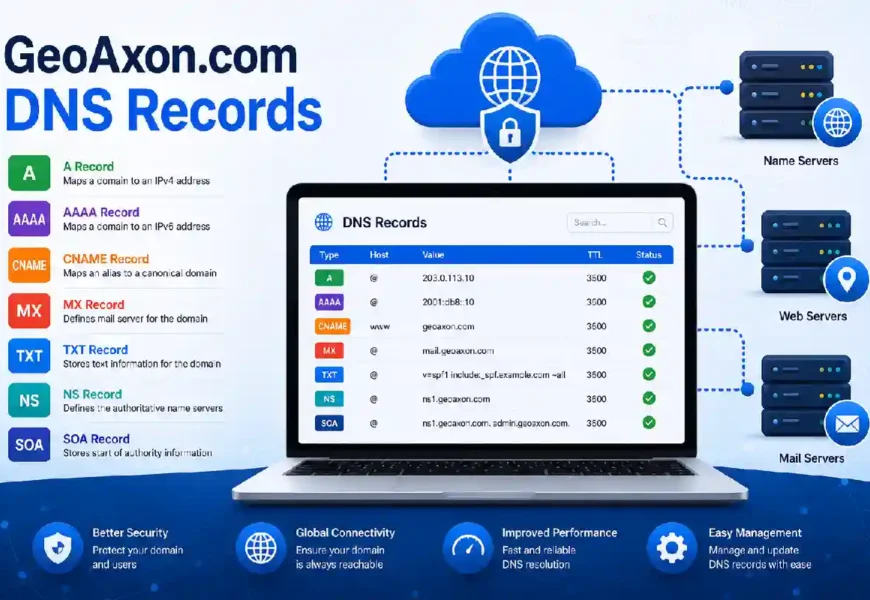
From the search “DNS records GeoAxon.com,” it appears that you might be researching the configuration of the domain or facing issues with your website or mail server.
DNS records are like the index or telephone book of the Internet that guides your browser on where to locate your website, mail server, and other Internet services. All domains, including GeoAxon.com, use DNS records.
In this tutorial, we will cover all types of DNS records along with their purpose and relevance to GeoAxon.com.
What Are DNS Records?
DNS records are orders stored on a domain’s authoritative nameservers.
They help computers determine:
- Where a website is hosted
- Which server receives email
- Which services are connected
- How security policies are applied
- Which certificates are authorized
Without DNS, visitors would need to remember IP addresses instead of domain names.
Understanding DNS records is also important from a broader security perspective. Learning about data security can help businesses recognize how protecting digital information supports a safer online environment.
Why DNS Records Matter
DNS records ensure that:
- Websites load correctly
- Emails reach the correct mailbox
- Subdomains function properly
- SSL certificates work
- Domain verification succeeds
- Cloud services connect successfully
Even a small DNS misconfiguration can lead to website downtime or email delivery problems.
Proper management of domain and network information should be part of a wider security strategy. Following secure data practices can help reduce unnecessary risks when handling sensitive digital information.
Common DNS Record Types
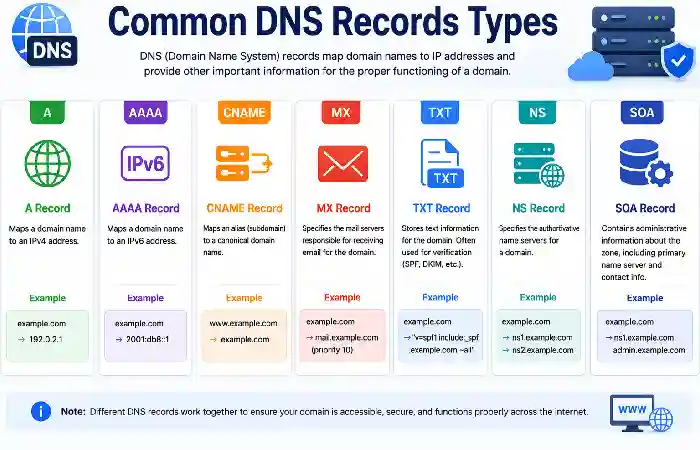
A Record
The A (Address) record maps a domain name to an IPv4 address.
Example purpose:
geoaxon.com
↓
Server IP
Without an A record, a website generally cannot be reached through its domain name.
AAAA Record
The AAAA record performs the same role as an A record but for IPv6 addresses.
Organizations adopting IPv6 publish AAAA records alongside or instead of IPv4 records.
MX Record
MX (Mail Exchange) records determine where incoming email is delivered.
They specify:
- Mail server
- Priority
- Backup servers
Incorrect MX records commonly result in undelivered email.
NS Record
Nameserver (NS) records identify the authoritative DNS servers responsible for the domain.
For example, public DNS information indicates that GeoAxon.com uses authoritative nameservers managed through Cloudflare.
TXT Record
TXT records store text information used for:
- SPF
- DKIM
- DMARC
- Google verification
- Microsoft verification
- Domain ownership
Many modern services require TXT records during setup.
CNAME Record
A CNAME creates an alias.
Example:
www.example.com
↓
example.com
This reduces duplicate DNS management.
SOA Record
SOA means Start of Authority.
It contains:
- Primary nameserver
- Administrative email
- Zone serial number
- Refresh interval
- Retry interval
- Expiration values
The SOA record helps DNS servers synchronize updates.
As businesses increasingly rely on connected online services, secure information exchange becomes important. Understanding safe data sharing across cloud services can help organizations manage information more securely across different platforms.
Public DNS Information for GeoAxon.com
GeoAxon is a medical technology company with an operational website and contact page. According to public DNS lookups, the site has the following DNS records needed for the proper functioning of a website: nameservers and authority records.
Please note that the DNS record can vary over time due to organizational changes in the web hosting provider, infrastructure modification, or e-mail service.
How DNS Resolution Works
Upon entering:
geoaxon.com
the user’s browser takes the following actions:
- Asks a DNS resolver.
- Detects the authoritative nameserver.
- Obtains the corresponding DNS record.
- Gets the IP address of the server.
- Conducts the connection to the web server.
- Accesses the website.
Why Businesses Monitor DNS
Companies regularly monitor DNS because problems can affect:
- Website availability
- Email delivery
- Customer trust
- Search engine indexing
- SSL certificates
- API integrations
Routine monitoring helps identify configuration errors before they impact users.
DNS and Email
Email depends on several DNS records working together.
These include:
- MX
- SPF
- DKIM
- DMARC
Together they help:
- Reduce spam
- Authenticate senders
- Improve email deliverability
- Protect against spoofing
Proper email DNS configuration is especially important for organizations that communicate with customers.
DNS Security Best Practices
Good DNS management includes:
- Using reputable DNS providers
- Enabling DNSSEC where supported
- Monitoring for unauthorized changes
- Reviewing records periodically
- Removing obsolete entries
- Protecting registrar accounts with multi-factor authentication
These practices reduce the risk of domain hijacking and misconfiguration.
Monitoring digital infrastructure can also help organizations identify unusual activity and maintain better visibility. Businesses can explore how surveillance systems support monitoring and security across different environments.
Common DNS Problems
| Problem | Possible Cause |
| Website not loading | Missing or incorrect A record |
| Email not arriving | MX record issue |
| SSL certificate errors | DNS propagation or certificate mismatch |
| Slow updates | High TTL values |
| Verification failures | Missing TXT record |
| Subdomain issues | Incorrect CNAME or A record |
Understanding TTL
TTL stands for Time To Live.
It is used to represent the time that the DNS resolver will cache the record before requesting the update.
Low TTL
- Facilitates quick dissemination of changes
- Makes more requests to the DNS
High TTL
- Lessens request traffic
- Difficulties in the dissemination of changes
TTL plays an important role in the process of migration or modification of a website.
DNS Propagation
Whenever any changes are made to the DNS, they do not affect everywhere immediately.
It depends on:
- TTL values
- ISP’s cache
- Public DNS servers
- The geographical position
Although sometimes some changes might become immediate, the complete process may take 48 hours.
How to Check DNS Records
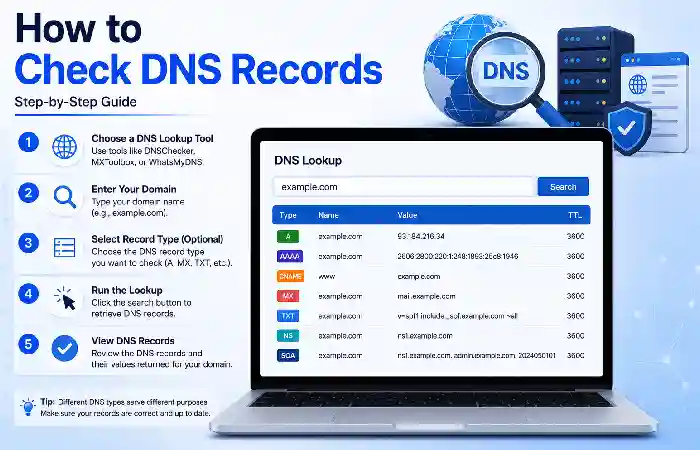
Several online DNS lookup tools allow you to inspect public records for any domain.
These tools can display:
- A records
- AAAA records
- MX records
- NS records
- TXT records
- CNAME records
- SOA records
- CAA records
They are useful for troubleshooting website and email configuration issues.
Best Practices for Managing DNS
If you manage a business website:
- Keep DNS documentation up to date.
- Review DNS records after hosting changes.
- Enable email authentication (SPF, DKIM, DMARC).
- Remove unused records.
- Monitor domain expiration dates.
- Secure registrar accounts with strong passwords and MFA.
These steps improve reliability and security.
DNS and cloud infrastructure can also play a role when businesses connect multiple digital systems. For organizations using Microsoft solutions, the Microsoft Dynamics 365 Cloud Connector can be relevant when integrating cloud-based business applications.
Frequently Asked Questions
What are GeoAxon.com DNS records?
The DNS records available publicly that are used to point to websites and email services for GeoAxon.com. These include the following types of records: A, MX, NS, TXT, and SOA.
Why would anyone check DNS records?
Typically, it could be due to the following reasons:
- To troubleshoot the website
- To verify the email setup
- To check nameservers
- To confirm the domain ownership
- To diagnose DNS propagation
Are DNS records ever changed?
Yes, since DNS records are updated whenever there is a change in the hosting or any other relevant change.
Are DNS records public?
Mostly yes, DNS records are generally available to the public since internet services depend on them.
Does GeoAxon.com provide contact information?
Yes, GeoAxon offers a contact page on which one can get in touch with the distributors and support teams of GeoAxon.
Final Thoughts
“GeoAxon.com DNS records” search results usually show a desire to know more about domain configuration and connection issues related to websites and emails. DNS records, such as A, MX, NS, TXT, CNAME, and SOA records, are crucial elements of any working domain on the Internet.
If you’re either a website manager or an IT specialist who needs to learn more about domain administration, then it’s highly important to know something about DNS records.
Syeda Yasmeen is a Marketing & Digital Business Writer at MarketingInno with 5 years of writing experience. She covers digital marketing, SEO, content strategy, branding, social media, online business, and emerging digital trends.
View Author Profile →
Sameena Begum is a health, technology, and digital content reviewer who reviews selected articles to help ensure that information is presented clearly, accurately, and responsibly.
View Reviewer Profile →