
Last Updated: August 23, 2026
Currently, influencer marketing is one of the most popular digital marketing tactics that allow you to reach the target audience via trustworthy people. Tomoson influencer marketing study is often quoted for its insights regarding the ROI of influencer marketing campaigns, customer quality, preferred platforms, and the growing importance of working with creators.
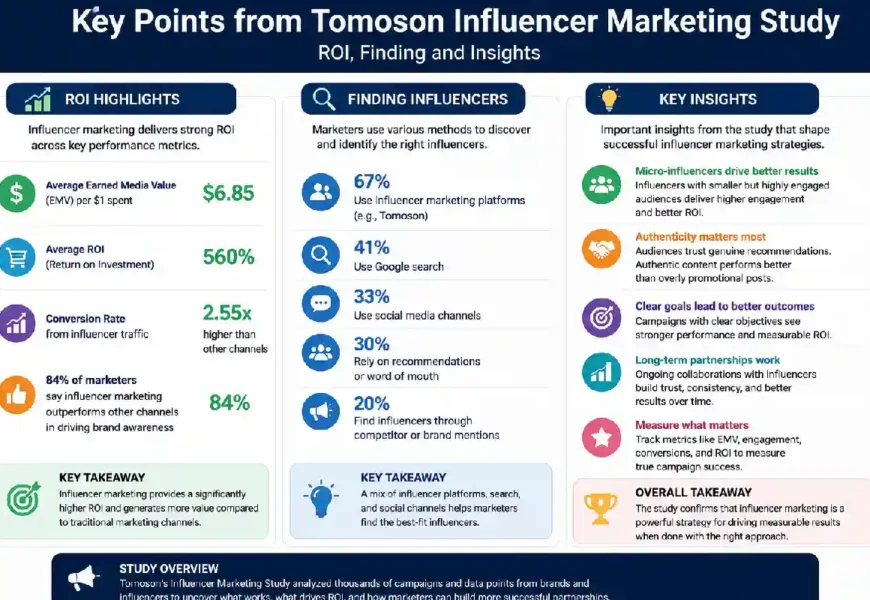
According to the results obtained by Tomoson, a company earns $6.50 for every dollar invested in an influencer marketing campaign, which proves the importance of engagement, trust, and customer quality.
However, these statistics are based on surveys that were held at a certain period of time and are not always relevant for contemporary campaigns.
What Is the Tomoson Influencer Marketing Study?
Tomoson influencer marketing study evaluated how marketers use influencer marketing campaigns and perceive their performance.
Research topics included:
- ROI
- Customer acquisition
- Marketing channels’ growth
- Preferred platforms
- Engagement
- Sales
- Brand awareness
The survey attracted public attention because it showed the potential of influencer marketing as a cost-effective customer acquisition channel.
Return of $6.50 for Each Dollar Invested
The return of $6.50 per dollar invested in influencer marketing campaigns is one of the key findings of Tomoson that gained a lot of publicity. According to the company, top-performing influencer marketing campaigns allow businesses to get more than $20 for each dollar invested.
Though the numbers show the potential of the marketing technique, they do not mean that each and every campaign will yield a high return on investment.
The performance of an influencer marketing campaign depends on several aspects, including:
- Industry
- Product type
- Influencer choice
- Audience quality
- Used platform
- Objectives
- Content quality
- Measurement techniques
- Conversions
A business needs to assess the results of its campaign rather than expect that the historical average can be applied in this case.
Influencer Marketing ROI and Revenue Growth
| ROI Factor | Impact on Businesses | Key Takeaway |
| Brand Awareness | Expands reach to targeted audiences | Influencers can introduce products to highly relevant followers |
| Audience Engagement | Encourages likes, comments, shares, and discussions | Higher engagement can strengthen customer interest |
| Sales & Conversions | Influencer recommendations can drive purchases | Trackable links and discount codes help measure results |
| Customer Trust | Personal recommendations can improve credibility | Authentic creator partnerships often feel more relatable |
| Content Creation | Provides reusable photos, videos, and social content | Brands can reduce the need to create every asset themselves |
| Repeat Customers | Strong creator campaigns can support long-term brand relationships | Consistent partnerships may improve customer retention |
| Revenue Growth | Successful campaigns can contribute directly to sales | ROI should be measured against campaign costs, conversions, and revenue |
Measruring Influencer Marketing Performances
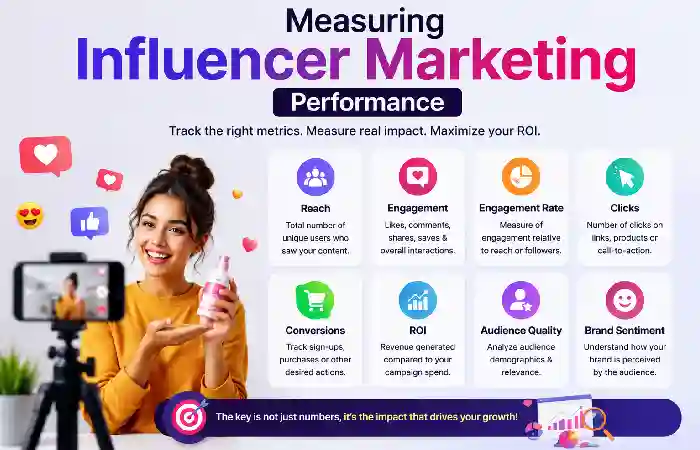
Besides the return on investment, the study conducted by Tomoson pays attention to the quality of customers acquired through influencer marketing campaigns. As per the results of the research, 51% of marketers believe that customers acquired using influencer marketing campaigns are of higher quality than those acquired by means of other methods.
This is important since, for success in marketing campaigns, it is necessary not only to drive traffic but also to attract:
- Target audience
- People interested in the product
- People willing to make a purchase
- People willing to make repeat purchases
- People willing to recommend the product
Influencer Marketing as a Customer Acquisition Channel
Influencer marketing was described by the researchers as a quickly-growing online customer acquisition channel. At that point in time, marketers started considering influencers as a channel similar to such well-established digital marketing channels as organic search and email marketing.
The situation has significantly changed since then as new platforms such as TikTok, Instagram, YouTube, and short-form video became more and more popular.
It is necessary to combine information from past studies with the data from current platforms and from first-party campaigns.
Preferred Platforms
In the original Tomoson study, blogs were considered to be the preferred influencer marketing platform for 37% of marketers, with Facebook at 25%.
However, platform preferences can change with changes in consumer behavior.
Nowadays, companies may collaborate with influencers who are active on platforms such as:
- TikTok
- YouTube
- Blogs
- Podcasts
- Newsletters
The appropriate platform choice depends on where the target audience spends their time and the format of content that best communicates a product message.
Why Influencer Trust Matters
The third point is the influence that creators build with their audience.
They usually build their community focusing on their interests, lifestyle, profession, or some hobby. The recommendation will be taken in case it is relevant and looks credible. Therefore, the follower’s reaction will be much better than in the case of ordinary advertising.
As Tomson mentioned, it is extremely important to build trust and credibility in the process of influencer relationship building. Nevertheless, the main component of credibility is the selection of the right creators with the appropriate audience and content.
Micro-Influencers and Niche Audience
It is not a priority to choose influencers based on the number of followers. Micro-influencers give a chance to reach a smaller but more focused audience. And nowadays, the role of micro-influencers is still highlighted in the recent Tomoson materials.
For instance, if there is a small company, it will be much easier for it to receive bigger audience coverage from several relevant creators rather than spending all the money on working with one big creator.
Steps to Take to Use the Study by a Brand
The brand doesn’t have to use this research as a guideline. It should follow the following steps instead:
- Define the goal of the campaign.
- Identify the target audience.
- Choose relevant influencers.
- Prepare to measure before starting the campaign.
- Create campaign guidelines.
- Track engagement and referral traffic.
- Track conversion and revenue.
- Compare results and campaign cost.
- Find out the best-performing creators.
- Improve future campaigns with first-party data.
Metrics that Should Be Used for Measuring Influencer Marketing Effectiveness
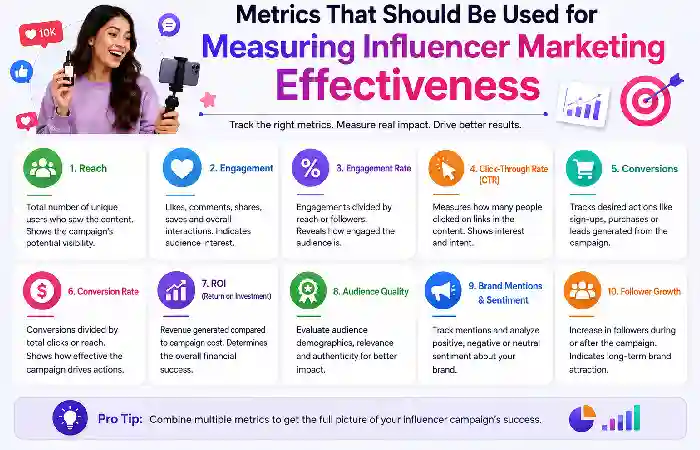
Return on investment was the main KPI in the previous Tomoson research. Nevertheless, today’s marketers should track not only ROI but also other KPIs. Here is the list of the most important KPIs:
- Reach
- Engagement rate
- Website visits
- Referral traffic
- Leads
- Sales
- Conversion rate
- Cost per acquisition
- Return on ad spend
- Customer retention
According to Tomoson’s guidelines for measuring influencer marketing, it is advised to define goals and KPIs before running any campaign and to use particular tracking tools, for example, UTM parameters and codes.
Influencer Selection and Campaign Success
| Factor | Impact on Campaign Success |
| Audience Relevance | Reaches the right target customers |
| Engagement Rate | Shows how actively followers interact |
| Content Quality | Builds trust and brand credibility |
| Authenticity | Makes promotions feel more genuine |
| Niche Expertise | Improves relevance and conversions |
| Past Performance | Helps predict campaign results |
Limitations of the Study
Historical marketing research must always consider within its initial context.
This widely referenced ROI number was a result of survey-based research and cannot consider a kind of controlled experiment or universal industry benchmark. Moreover, independent analysis of this ROI revealed the fact that there can be differences due to varying definitions used to measure ROI.
The influencer landscape has also changed dramatically since the time of this original research. Platforms, creator formats, advertising regulations, attribution technologies, and consumer behavior have all changed now.
Tomoson Influencer Marketing Today
Today, Tomoson continues to produce resources dedicated to influencer marketing with respect to campaign measurement, creator searching, ROI, micro-influencers, UGC, and influencer outreach.
Current Tomoson material clearly illustrates the development of influencer marketing as a practice, which evolved from blog reviews into social video marketing, user-generated content marketing, affiliate marketing, and other types of performance-based creator partnerships.
Frequently Asked Questions
What are the results of Tomoson’s study of influencer marketing?
The average return on investment of $6.50 for every one dollar spent on influencer marketing is reveal by the research, together with the quality of customers, preferred platform, and engagement via influencers.
Is the ROI of $6.50 guaranteed?
No, it is just an historical result of the research and cannot consider a guarantee of ROI for any specific campaign. The ROI depends on the audience, industry, creators, platform, content, and ROI calculation methodology.
Why does influencer marketing work?
Influencer marketing allows brands to reach establish communities due to influence and a good relationship between creators and their audiences.
Are micro-influencers helpful for a brand?
Yes, micro-influencers will help a brand reach the relevant audience if niche relevancy is required instead of the number of followers.
What metrics should brands use?
The metrics that brands need to use depend on the objectives and can include engagement, traffic, leads, sales, conversion rate, cost per acquisition, and ROAS.
Conclusion
The study conducted by Tomoson on influencer marketing can bconsider a useful source of information about the early stages of development of influencer marketing. This study proves the power of collaboration with creators, but the ROI indicated there ($6.50 for every dollar) is only historical data from the survey.
Nowadays, brands can benefit from the value of trust, the quality of the audience, and creator collaboration with an analytical approach. It is crucial to define objectives, relevant creators, metrics, and performance data for evaluating the effectiveness of the influencer marketing campaign.